What a scoped pilot covers
- One live workflow or agent path
- One clearly defined problem to solve
- One narrow control approach to test
- One reviewable set of outputs
Many teams already have policies, reviews, and standards language in place. The gap is runtime: when a live workflow actually acts, there is often no clear, reviewable decision about what the system may do, what it must refuse, and when it should escalate.
The solution is a scoped pilot around one live workflow. It tests whether that workflow can be brought under clearer control with explicit decisions, stronger boundaries, and usable evidence after the fact.
GEN-FIT gives the pilot a reviewable structure for expressing rules, decisions, and boundaries in a form teams can actually work with.

Policies, model cards, and training do not decide whether an action is allowed at runtime.
If a system cannot decide what it is allowed to do, other problems stack up fast: data leaks, policy drift, weak accountability after harm, and errors that spread at scale.
Define whether one workflow can be made governable before you commit to a broader control program.
The strongest recurring problem is not that teams lack policy language. It is that live systems still lack a deterministic way to decide what is permitted before they act.
Once that decision surface is missing, other failures stack on top of it: data use drifts outside permissioned boundaries, policy and jurisdiction do not bind at runtime, and teams cannot explain what happened after an incident.
The pilot uses that stack as a scoping tool so the work starts with a concrete workflow problem rather than a generic governance discussion.
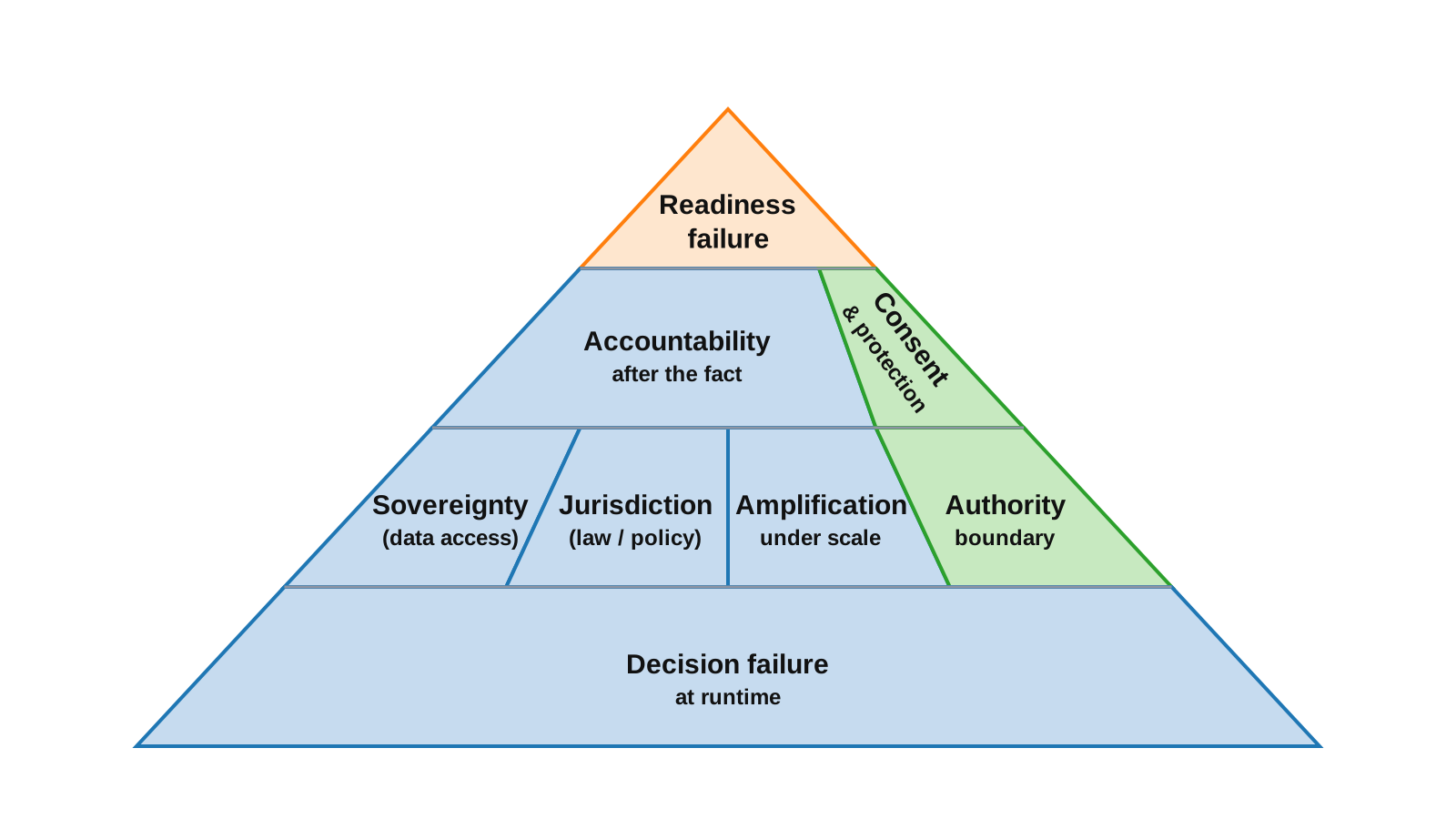
The pilot usually starts near the base of the pyramid: decision failure at runtime. If a team cannot make an explicit allow, refuse, constrain, or escalate decision in one live workflow, the rest of the governance stack stays fragile.
A pilot can focus on permission-bound retrieval, transformation before exposure, and fail-closed behavior when access constraints cannot be satisfied.
A pilot can test whether one workflow can bind the right constraints at runtime, including jurisdiction, internal policy, and escalation conditions.
A pilot can define the record needed to explain why an action was allowed, constrained, refused, or escalated.
If you already have a live or near-live AI workflow in mind, the next step is a scoped pilot discussion. The aim is to decide whether that workflow is a good fit for a narrow, practical control pilot.